

Business Operation · 2025
In this section21 topics
- Corporate Information4 items
- Dividend Policy2 items
- Major Shareholders1 item
- Business Strategies Overview5 items
- Material Changes & Developments1 item
- Use of Proceeds from Securities Offerings1 item
- Commitments Made in the Registration Statement1 item
- Group Operating-Structure Policy1 item
- Shareholders with Potential Conflict of Interest1 item
- Relationships Among Major Shareholders1 item
- Shareholders' Agreement1 item
- Shareholding Diagram (Group Structure)1 item
- Income Structure3 items
- Product / Service Characteristics2 items
- Research & Development6 items
- Assets Used in the Business5 items
- Marketing Policy & Competition3 items
- Procurement of Products & Services6 items
- Projects Under Construction1 item
- Debentures & Bills of Exchange1 item
- Convertible Securities1 item
Corporate Information
Company Name
Maguro Group Public Company Limited
Telephone
09-1923-5539
Website
www.maguro.co.th
IR@magurogroup.com / ComSec@magurogroup.com
Dividend Policy
Dividend Policy
The Company has a policy to pay dividends to shareholders at a rate of not less than 40.00 percent of the net profit based on the separate financial statements, after deduction of corporate income tax and after allocation to the statutory reserve in accordance with applicable laws and the Company’s Articles of Association. However, such dividend payment may be subject to change, depending on the Company’s operating results, investment plans, financial position, liquidity, business expansion plans, and other relevant factors, including future business management considerations, as deemed appropriate by the Board of Directors. The annual dividend payment shall be subject to approval by the shareholders’ meeting, except for interim dividends. The Board of Directors is authorized to approve interim dividend payments from time to time when it considers that the Company has sufficient profits to do so without adversely affecting the Company’s operations.
Historical Dividend Payments
| This Year | Last Year | 2 Years Ago | Metric | Description |
|---|---|---|---|---|
| 1.18 | 0.83 | 0.69 | Net profit per share (Baht : Share) | Net profit per share (baht : share) |
| 0.55 | 0.4 | 0.82 | Dividend per share (Baht : Share) | Dividend per share (baht : share) |
| 0 | 0 | 0 | Dividend stock ratio (Number of original shares: dividend shares) | Ratio of stock dividend payment (existing share : stock dividend) |
| 0.55 | 0.4 | 0.82 | Dividend share value per share (Baht : Share) | Value of stock dividend per share (baht : share) |
| 0.55 | 0.4 | 0.82 | Total dividend payment value (Baht : Share) | Total dividend payment (baht : share) |
| 46.67 | 48.16 | 118.19 | Dividend payout ratio to net profit (%) | Dividend payout ratio compared to net profit (%) |
Business Strategies Overview
Chairman's Message
2025 marked another year of continued growth for Maguro Group Public Company Limited, despite ongoing economic uncertainties and intensifying competition in the restaurant industry. The Board of Directors is pleased with the Company’s performance, which reflects the strength of its strategy, disciplined management, and the dedication of management and employees at all levels in continuously developing brands, products, and services to meet evolving consumer needs.
During the year, the Company achieved satisfactory growth in both revenue and operating results, alongside the expansion of branches and development of brands in line with its strategic plan. The Company remains committed to quality growth by maintaining profitability and managing costs efficiently. These efforts underscore the Company’s progress in establishing itself as a multi-brand restaurant group, supported by an integrated management system and expertise in brand development and management—covering both in-house brands and those entrusted by international partners—thereby strengthening its foundation for long-term growth.
The Company has continuously expanded its brand portfolio through both internal brand development and partnerships with international brands entering the Thai market. This reflects strong confidence in the Company’s capabilities as a professional restaurant operator with recognized standards in quality control and operations, as well as its ability to effectively scale businesses in collaboration with partners. In addition, the Company has focused on expanding branches in strategic locations, enhancing the efficiency of its central kitchen, and investing in information technology systems to improve operational capabilities and support future growth.
Following its listing on the Stock Exchange of Thailand, the Company has prudently executed its investment plans. The Board of Directors has closely monitored capital deployment, branch expansion, and operational risks to ensure that growth remains appropriate, financially disciplined, and aligned with shareholders’ interests, while also taking into account all stakeholders. Despite continued volatility in consumer purchasing power, raw material costs, and operating expenses, the Company has been able to maintain satisfactory sales growth and profitability, particularly in same-store sales and dine-in revenue. This reflects the strength of its brands and the continued trust of customers in the quality of its products and services.
The Board places strong emphasis on good corporate governance, risk management, and sustainable business practices. It ensures that the Company operates with transparency, maintains appropriate internal control systems, and considers all stakeholders. The Company is committed to reducing environmental impact, using resources efficiently, developing its people, and ensuring food quality and safety, while maintaining operational standards across all brands and contributing to social development. These efforts are undertaken alongside business growth to create long-term value.
Looking ahead to 2026 and beyond, the Company expects to continue facing challenges from economic conditions, raw material costs, and increasing competition. Nevertheless, the Board of Directors remains confident that, with its strong business fundamentals, financial discipline, and prudent expansion strategy, the Company will continue to grow sustainably and deliver appropriate returns to shareholders over the long term.
Finally, on behalf of the Board of Directors, we would like to express our sincere appreciation to shareholders, management, employees, and all stakeholders for their continued trust and support. The Board remains committed to performing its duties with responsibility, prudence, and adherence to good corporate governance principles to ensure that the Company grows steadily, transparently, and sustainably.
Vision
To be a leading organization that delivers valuable, high-quality, and creative dining experiences, committed to enhancing value for customers, employees, partners, shareholders, and other stakeholders.
Objectives
Strive to Create a Valuable and Quality Dining Experience: The company will focus on serving customers with high-quality menu items that meet their needs, while also creating a positive experience with every meal for the customers.
Strengthen Relationships with Customers, Employees, Partners, and Shareholders: Emphasize the importance of building and maintaining strong and sustainable relationships with all stakeholders, including customers, employees, partners, and shareholders.
Increase Value for Stakeholders: The company is committed to increasing real value for all parties involved by improving product and service quality, creating new business opportunities, and managing operations effectively.
Develop Sustainably and Responsibly for Society: Conduct business that is both sustainable and socially responsible by supporting activities that benefit society and the environment.
Goals
Develop and expand new brands continuously: The development and introduction of new brands into the Company’s portfolio to strengthen the business, broaden the customer base, and better address the diverse needs of consumers.
Continuous Expansion of Branches: Increase the number of branches both domestically and internationally to enhance customer reach and expand the market sustainably.
Customer Satisfaction: Enhance the customer experience through excellent service, a diverse and valuable menu, while ensuring the quality of food is consistently maintained across all branches.
Organizational and Employee Development: Develop the potential of employees at all levels to ensure their ability to provide efficient service and management, with a focus on skill development and creating opportunities for growth within the organization.
Sustainable Profit Growth: Strive to achieve sustainable profit growth by using strategies to increase sales, reduce costs, and manage resources efficiently.
Business Strategies
Market and Branch Expansion: Focus on expanding branches both domestically and internationally by selecting locations with high market potential and meeting the needs of target customer groups.
Customer Relationship Management (CRM): Develop and implement a customer relationship management system to build strong relationships and increase customer satisfaction, both in terms of service and products.
Product Development and Innovation: Focus on developing new food menu items and introducing innovations that can better meet customer needs in terms of quality, taste, and variety.
Organizational and Employee Development: Provide training and skill development for employees at all levels, particularly for those in management positions, to enable them to drive the organization towards its set goals.
Effective Financial and Cost Management: Improve financial processes and cost management to increase profitability and sustainable earnings.
Sustainability and Corporate Social Responsibility: Engage in activities that are socially and environmentally responsible by using resources efficiently and supporting activities that benefit society.
Material Changes & Developments
Material Changes & Developments
| Year | Description |
|---|---|
| 2,015 |
|
| 2,016 |
|
| 2,017 |
|
| 2,018 |
|
| 2,019 |
|
| 2,020 |
|
| 2,021 |
|
| 2,022 |
|
| 2,023 |
|
| 2,024 |
|
| 2,025 |
|
Use of Proceeds from Securities Offerings
Is There Money Raised from a Securities Offering Still to Report On?
No
Commitments Made in the Registration Statement
Are There Commitments or Conditions from an Offering or Listing?
No
Group Operating-Structure Policy
Description
The Company does not have information regarding the operational division policy of the group at present.
Income Structure
Product / Service Income
| Category | Description | This Year | This Year % | Last Year | Last Year % | 2 Years Ago | 2 Years Ago % |
|---|---|---|---|---|---|---|---|
| Total revenue from operations | Total revenue from operations | 1,980,832.74 | 100 | 1,373,294.47 | 100 | 1,043,553.32 | 100 |
| Revenue from restaurant business | 1,977,563.92 | 99.83 | 1,371,155.78 | 99.84 | 1,041,697.71 | 99.82 | |
| Revenue from catering and delivery | 3,268.82 | 0.17 | 2,138.69 | 0.16 | 1,855.61 | 0.18 | |
| Other | Other | 0 | 0 | 0 | 0 | 0 | 0 |
Export Income
| Category | Description | This Year | This Year % | Last Year | Last Year % | 2 Years Ago | 2 Years Ago % |
|---|---|---|---|---|---|---|---|
| Total revenue | Total revenue from operations | 1,980,832.74 | 100 | 1,373,294.47 | 100 | 1,043,553.32 | 100 |
| Domestic | Domestic | 1,980,832.74 | 100 | 1,373,294.47 | 100 | 1,043,553.32 | 100 |
| International | International | 0 | 0 | 0 | 0 | 0 | 0 |
Other Income
| Operating Other Income | Non-Operating Other Income | Share of Profit |
|---|---|---|
| 1710 · As of year: 9408.4 · Description: Total other income · As of yesteryear: 5814.05 · As of year before yesteryear: 2257.75 · 1711 · As of year: 8104.48 · Description: Other income from operations · As of yesteryear: 4939.05 · As of year before yesteryear: 2257.75 | 1712 · As of year: 1303.92 · Description: Other income not from operations · As of yesteryear: 875.0 · As of year before yesteryear: 0.0 · 1303.92 · Description: Other gains (losses) · As of yesteryear: 875.0 | 1713 · As of year: 0.0 · Description: Share of profit · As of yesteryear: 0.0 · As of year before yesteryear: 0.0 |
Product / Service Characteristics
Business Type
3114
Business Groups
| Business Group | Description |
|---|---|
| MAGURO Group | Maguro Group Co., Ltd. (Public) ("the Company") is in the restaurant business, selling food and beverages, as well as providing food delivery services and catering services under the brand name "Maguro." The Company believes that "we are not just a restaurant," but that we are driven by the impression of the Japanese philosophy of "Give More," which is what we wish to offer to the people of Thailand. This is reflected in our use of the highest quality ingredients, prepared with respect for the ingredients and an understanding of the art of sushi, all at a sincere, reasonable, and valuable price. Our aim is to give customers the most enjoyable moments with their loved ones. With this intention, the first Maguro restaurant was established at Chic Republic, Bangna, on May 27, 2015. The Company has continuously developed its food quality, service, and new brands to offer new types of food and services. As of December 31, 2025, the Company operates 7 restaurant brands and 53 restaurant locations covering the Bangkok metropolitan area and surrounding areas, as detailed below: |
| MAGURO |
|
| SSAMTHING TOGETHER |
|
| HITORI SHABU & HITORI SUKIYAKI |
|
| TONKATSU AOKI |
|
| CouCou |
|
| Bincho |
|
| Kiwamiya |
|
| CATERING | The Group has developed a customer relationship management system and membership program to support its service offerings and enhance the overall customer experience. The Company utilizes the Salesforce CRM system as a key tool for managing customer data and delivering benefits to members. This system serves as an integral part of the Company’s service operations, enhancing convenience, ensuring service continuity, and increasing customer engagement across its platforms. The Company offers off-premise catering services, delivering premium catering experiences for a wide range of occasions, including corporate customers requiring high-quality food for meetings, seminars, and corporate events, as well as individual customers seeking catering services for private functions, weddings, and special celebrations. In addition to on-site catering services for various events, the Company also offers high-quality box set meal options designed to meet the needs of business meetings, seminars, and special occasions that require premium meals in a convenient format. These offerings are well suited for corporate clients seeking to create a lasting impression on their guests. |
| Delivery | The Company offers food delivery services with the intention of making its dining experience more accessible and convenient for customers, wherever they are. The service was first introduced in 2020, delivering a wide variety of menu items prepared using high-quality ingredients, offering premium quality at value-for-money pricing comparable to dine-in. The Company places strong emphasis on service quality and attention to detail to ensure that customers receive the best possible dining experience with every order. The taste, quality, and presentation of the food are consistently maintained to reflect the same standards as dining at the restaurant. Each order reflects the Company’s commitment to delivering high-quality meals, ensuring that every dining experience is both worthwhile and memorable. |
| An image showing the locations of branches of restaurant brands under the Maguro Group (total 53 branches) | This map illustrates the locations of all 53 restaurant branches under the Company’s operations, reflecting the expansion of the business and its coverage across various regions, particularly in high-potential and high-traffic locations. |
Research & Development
Has R&D Policy (Y/N)
No
R&D Cost — Description
1. Expenses for studying food products from other operators
The Company incurs expenses in studying, testing, and analyzing food products from other operators with similar product characteristics or operating in the same market. Such activities are conducted to compare product quality, taste, presentation, and consumer trends. The information obtained is used to support the development of new menu items and the improvement of existing products to ensure alignment with market competition, as well as to maintain product standards and enhance the Company’s competitiveness.
2. Raw material costs used for research and development
These expenses consist of the cost of ingredients used in developing new menu items, improving existing recipes, and testing alternative raw materials. Such activities are carried out to control costs while maintaining appropriate product quality under changing raw material price conditions.
3. Test run expenses prior to actual store operations
The Company incurs expenses from trial operations prior to the opening of new branches. These expenses include costs related to staff training, product preparation trials, and operational system testing in order to ensure readiness in terms of product quality, service standards, and operational efficiency before the official opening. The Company considers research and development activities as part of its normal business operations to support continuous growth and maintain its long-term competitiveness.
R&D Cost — Label
Research and development (R&D) expenses over the past 3 years (Million Baht)
R&D Cost — This Year
5309.2
R&D Cost — Last Year
3632.51
R&D Cost — 2 Years Ago
2434.95
Assets Used in the Business
Permanent Assets — Description
As of 31 December 2025, the Company’s property, plant and equipment consisted of buildings, building improvements and utilities, furniture and fixtures, office equipment, kitchen equipment, and computer equipment. The net book value of property, plant and equipment, as presented in the Company’s financial statements, amounted to Baht 502.79 million baht, representing 28.2% of the Company’s total assets.
Permanent Assets — Appraisal
| Asset | Ownership | Obligation | Appraisal Value |
|---|---|---|---|
| Buildings, building improvements and public utility systems | Owner | None | 314.34 |
| Furniture, decorations and office equipment | Owner | None | 75.33 |
| Kitchen equipment | Owner | None | 83.47 |
| Computer equipment | Owner | None | 21.22 |
| Assets under construction | Owner | None | 8.42 |
Intangible Assets — Description
As of 31 December 2025, the Company’s intangible assets consisted of computer software licenses, with a net book value of Baht 47.66 million baht as presented in the Company’s financial statements, representing 2.7% of the Company’s total assets.
Has Subsidiaries Investment Policy (Y/N)
Yes
Subsidiaries Investment Policy — Description
The Company has established policies for the governance of its subsidiaries and associates to ensure effective oversight and management, in alignment with the Company’s objectives, growth direction, and strategic plans, as well as in compliance with applicable laws and regulations. The Board of Directors plays a key role in overseeing and closely monitoring the operations of subsidiaries and associates.
The Company considers appointing its representatives to serve as directors or executives in subsidiaries and associates in proportion to its shareholding, in order to ensure that operations are conducted in accordance with the Company’s policies and principles of good corporate governance. Such appointments are subject to approval by the Board of Directors.
For significant transactions, subsidiaries are required to obtain approval from the Board of Directors and/or the shareholders’ meeting and/or relevant regulatory authorities, as required by applicable laws, prior to execution. Related party transactions must be conducted based on sound business rationale, on an arm’s length basis, and with transparent disclosure to prevent conflicts of interest.
Subsidiaries and associates are required to report their financial position, operating results, and any transactions that may give rise to conflicts of interest to the Company in a complete and timely manner. The Company has established appropriate and adequate disclosure systems and internal control systems.
In addition, the Company continuously monitors the performance of its subsidiaries and associates, and conducts analysis and provides recommendations to the Board of Directors to support sustainable business development and growth.
Marketing Policy & Competition
Reporting Mode
3117
Marketing Policy (Overall)
In 2025, the Company implemented its marketing strategy with a focus on strengthening restaurant brand quality, delivering distinctive dining experiences, and responding to evolving consumer behavior in order to enhance customer satisfaction and loyalty. To sustain its success and support long-term growth, the Company has established a Strategic Growth Framework, focusing on sustainable growth through strengthening brand positioning and deepening consumer understanding to create value for customers, shareholders, and all stakeholders.
The Company aims to enhance the performance of its existing businesses while expanding market opportunities and developing new revenue streams. In addition, the Company focuses on capability development across human resources, management systems, and operational standards to effectively support future business growth.
The Company has defined four key strategic pillars to drive business growth, as follows:
1. Same Store Growth
The Company places strong emphasis on enhancing the performance of existing branches to drive continuous revenue growth by increasing customer traffic and average spending per bill. This is achieved through continuous menu development, seasonal menu offerings, and the creation of diverse dining occasions to respond to changing consumer behavior.
At the same time, the Company focuses on developing its membership program and Customer Relationship Management (CRM) system by leveraging in-depth customer data analytics to develop targeted marketing campaigns and personalized promotions. The Company also promotes cross-brand engagement across its portfolio, which helps increase customer visit frequency and strengthen long-term brand loyalty.
In addition, the Company aims to expand revenue opportunities from existing branches by developing additional service channels, including off-premise catering services for various occasions such as weddings, corporate events, and social gatherings, as well as food delivery services to align with evolving consumption patterns.
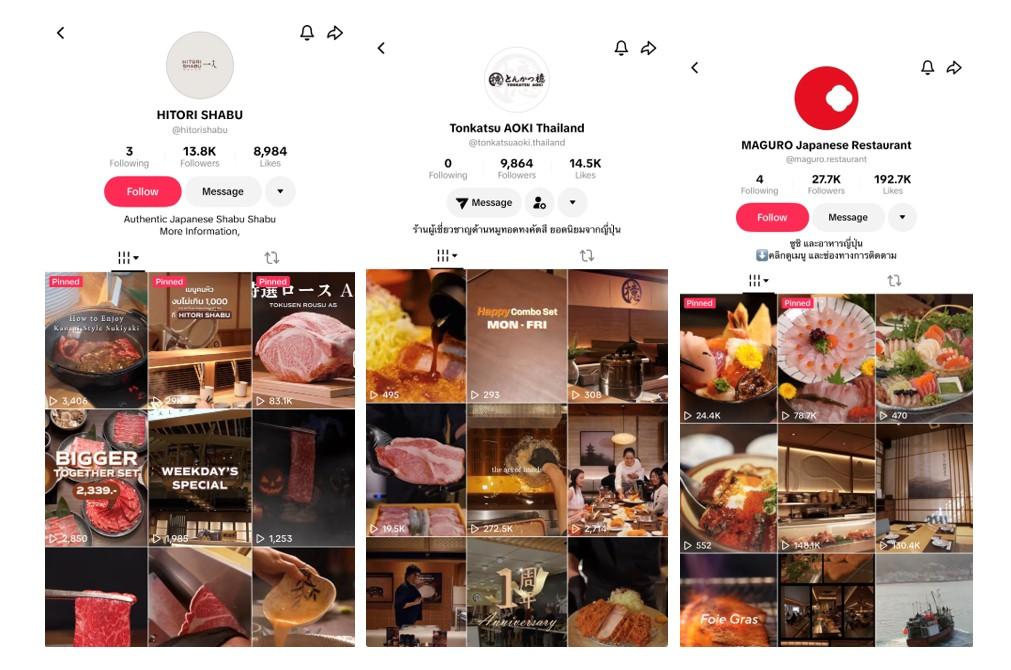
The Company also places strong emphasis on marketing communication through digital and social media platforms, including Line, Facebook, Instagram, and TikTok, to effectively communicate new menu offerings, promotional campaigns, and marketing activities to target customers. This enhances customer reach and supports continuous same store sales growth.
2. Strategic Store Expansion
The Company has a plan to continuously expand branches of its core brands to increase customer accessibility and support long-term business growth. The Company places strong emphasis on analyzing location potential, consumer behavior, and market opportunities in each area to ensure that new branch investments generate appropriate returns and effectively support the Company’s growth.
The Company focuses on expanding branches in high-potential locations, including Bangkok and its surrounding areas, as well as key provincial economic zones, to increase access to a broader customer base and support the growth in purchasing power across different areas.
In addition to standard store formats, the Company has developed a compact format restaurant model, which requires an appropriate level of investment per branch and provides greater flexibility in location selection. This model enhances expansion opportunities across various commercial areas and improves investment efficiency per branch.
This expansion strategy enables the Company to achieve continuous and sustainable growth, while also creating opportunities to expand into new areas, including potential expansion into international markets in the future.
3. Value Chain Optimization
The Company places strong emphasis on improving operational efficiency across the entire value chain, from raw material sourcing and central kitchen processing to branch-level operations. This ensures consistent food quality and service standards, while effectively managing costs and supporting future business expansion.
The Company focuses on strengthening its sourcing system to ensure quality and continuity, with an emphasis on increasing the proportion of locally sourced raw materials to reduce reliance on imports and support domestic suppliers. This enhances supply chain flexibility and strengthens long-term business stability.
At the same time, the Company continuously improves central kitchen operations and inventory management systems to maintain consistent food quality across all branches, improve cost efficiency, and support future branch expansion.
In addition, the Company places importance on sustainable business practices by implementing measures to reduce environmental impact, such as reducing plastic usage and initiatives to lower greenhouse gas emissions, in line with its long-term environmental and sustainability commitments.
4. New Brand and New Revenue Stream
The Company aims to drive long-term growth through the development of new restaurant brands that cater to diverse consumer segments. This strategy supports business diversification, enables access to new customer groups, and captures market opportunities across different consumption occasions, leveraging the Company’s expertise in brand concept development, dining experience design, and restaurant management in alignment with evolving consumer behavior.
The Company continuously studies market gaps and consumption trends to develop unique and differentiated brands, while expanding its restaurant portfolio to enhance business diversification. This enables the Company to reach new customer segments and create additional growth opportunities in the future.
In addition, the Company is exploring opportunities to develop ready-to-eat (RTE) and ready-to-drink (RTD) products to align with changing consumer behavior and create new revenue streams in the long term. This strategy enables the Company to diversify its revenue sources, reduce reliance on any single business model, and enhance its potential for sustainable growth.
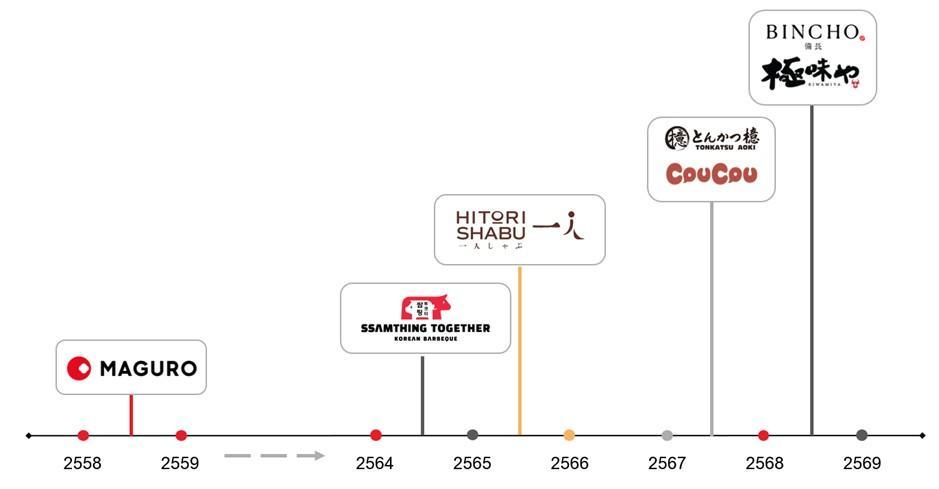
The Company’s first restaurant brand, MAGURO, was established in 2015 as a Japanese restaurant that emphasizes high-quality ingredient selection, continuous menu development and innovation, and ongoing enhancement of attentive and customer-centric service standards to make customers feel truly valued, while offering honest pricing and strong value for money under the “Give More” culture.
In 2021, the Company launched SSAMTHING TOGETHER, a mass-market Korean barbecue restaurant concept offering a wide variety of authentic Korean cuisine through premium ingredients, bold flavors, and attentive service, including food grilling service from the first grill, menu explanation, and continuous serving of Korean side dishes and fresh vegetables from organic farms throughout the dining experience. In the following year, in 2022, the Company launched HITORI SHABU, a premium Japanese sukiyaki and shabu-shabu restaurant concept. In 2024, the Company launched TONKATSU AOKI and COUCOU. In 2025, the Company launched BINCHO and KIWAMIYA, respectively.
Brand Development Timeline
Industry & Competition (Overall)
Strengths and Competitive Advantages of the Company
1. Focus on Quality, Affordable Pricing, Value, and Customer Experience
The Company emphasizes three key factors that form the core of its competitive advantage:
1.1 Maintaining High-Quality Ingredients – The Company prioritizes strict selection and quality control of raw materials at every stage to ensure that food delivered to customers is fresh and meets the highest standards.
1.2 Affordable and Value-for-Money Pricing – The Company sets prices that are appropriate and aligned with the quality and portion of the food offered, effectively catering to a diverse consumer base.
1.3 Customer Experience and Excellent Service – The Company focuses on designing a comfortable and welcoming in-store environment while providing attentive and friendly service, creating memorable dining experiences for customers.
These approaches enable the Company to differentiate itself and elevate the customer experience, thereby strengthening its competitive position.
2. Opportunities for Continuous Branch Expansion
As of 31 December 2025, the Company operates a total of 53 branches, including:
Maguro: 20 branches
Ssamething Together: 6 branches
Hitori Shabu: 15 branches
Hitori Sukiyaki: 1 branch
Tonkatsu Aoki: 7 branches
Coucou: 2 branches
Bincho: 1 branch
Kiwamiya: 1 branch
The current number of branches remains lower compared to major competitors, particularly publicly listed Japanese and Korean restaurant brands with 40–50 branches per brand.
This highlights growth opportunities that the Company can leverage by capitalizing on its product quality and brand image to expand further, both in Bangkok, the metropolitan area, and major provincial cities.
The Company’s branch locations are diversified: 25% in community malls, 36% in shopping malls, and 8% stand-alone stores. This demonstrates strategic location selection, flexibility in expansion, and effective rental cost management.
Building on this potential, the Company developed the stand-alone restaurant concept “The Flavorhood”, which has been well received by the market. The Company plans to use this prototype to guide future expansion, particularly stand-alone branches, to create additional growth avenues, long-term revenue sources, and integrate Environmental, Social, and Governance (ESG) considerations into business operations.
3. Young and Affluent Customer Base
The Company’s restaurants primarily serve young individual and family consumers in the working-age group with medium to high income. These customers value food quality, affordability, and service experience.
The Company has a social media following of over 841,600 accounts, reflecting strong brand awareness and consumer engagement.
Additionally, the Company has developed and enhanced a loyalty program, Give More+ Club, covering all brands under the group to foster long-term customer relationships. As of 31 December 2025, the program had over 290,682 members, mostly aged 25–34 and 35–44, representing a high-potential consumer segment with strong purchasing power and repeat visitation patterns, both for individual dining and family us.
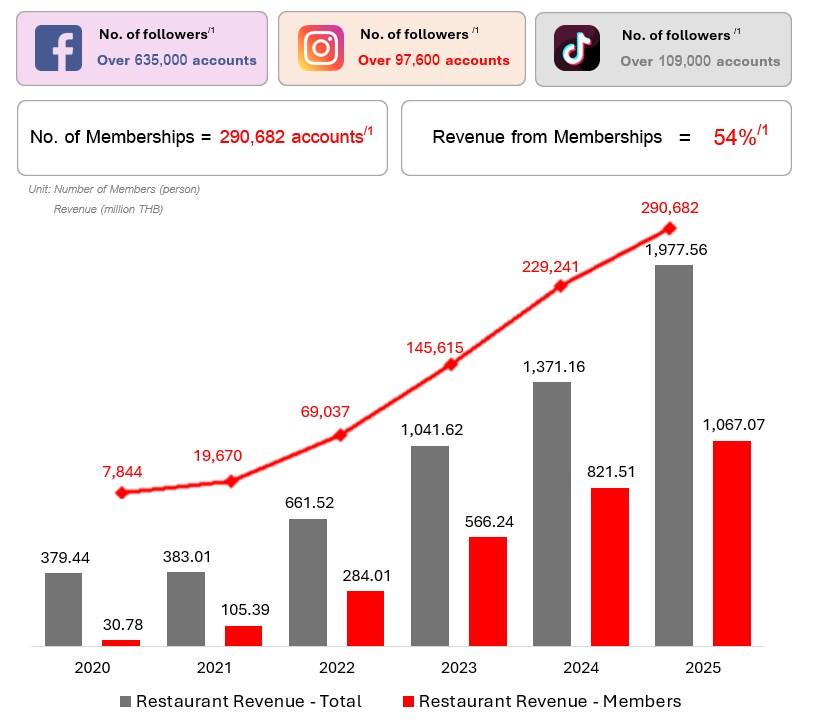
Note: /1 Number of followers for each brand, broken down by platform, as of 31 December 2025
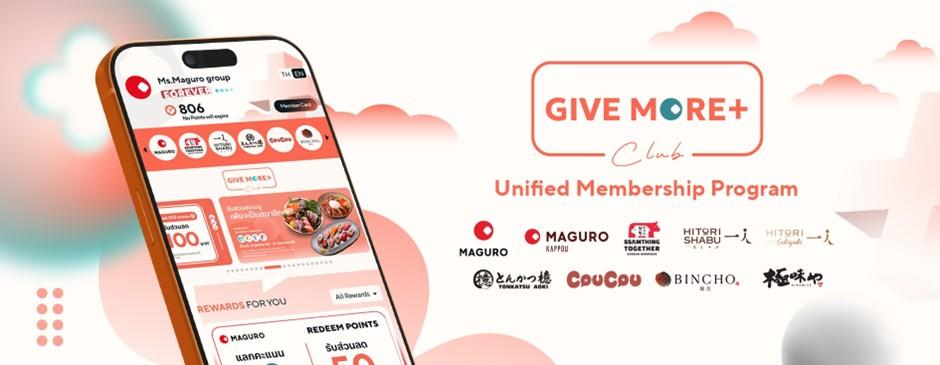
In 2025, the Company implemented a major restructuring of its membership and customer relationship management (CRM) system, transitioning from brand-specific systems to a centralized Unified CRM. This initiative strengthens the management of the customer base at the group level, enhances convenience for member customers, and supports systematic cross-brand engagement within the group.
Under this structure, the Company utilizes customer data for data-driven analysis to develop targeted marketing campaigns and personalized promotions, as well as to design activities that encourage cross-brand engagement. These efforts help increase customer visit frequency, strengthen brand loyalty, and improve the quality of the customer base over the long term.
Additionally, the Company developed a new Unified Web Application as a central platform for the Give More+ Club membership system. The platform is designed for ease of use and intuitiveness, integrating customer data and benefits across all brands in the group. This enhances the customer experience and establishes a technological foundation to support future business growth.
These initiatives enable the Company to retain and expand a high-quality customer base, reinforce competitive strength, and support sustainable revenue growth in the highly competitive restaurant industry.
4. Expertise in Develoing New Brands with Collaborative R&D and Marketing Teams
The Company continuously seeks market opportunities and gaps to develop and offer products and services that deliver clear differentiated value in terms of price, taste, quality, and portion size, while upholding the “Give More” service culture.
The Company has dedicated research & development (R&D) and marketing teams that work closely together, from studying market trends and consumer behavior to designing innovative products and services with appropriate cost structures. This approach supports the long-term growth of the business.
Leveraging this expertise, the Company successfully developed the Ssamthing Together and Hitori brands, which have expanded their branches and received positive market reception, demonstrating the ability to create brands that effectively meet the target consumer segment. In 2025, the Company launched two additional brands, CouCou and Bincho, which received positive initial market response and further strengthened the Company’s brand portfolio. In 2025, these brands contributed approximately 9%, 27%, 3%, and 2%, respectively, to the Company’s total revenue from sales and services.
5. Marketing in New Formats with a Focus on Digital Marketing and Technology-Enabled Business Operations
Procurement of Products & Services
Introduction
The Company’s product and service procurement can be divided into two main parts as follows:
1. Central Kitchen
Since March 2022 to the present, the Company leased a central kitchen to produce and store products, located on Soi Chalermprakiat R.9, with a usable area of approximately 700 square meters. The central kitchen can support production for up to 40 branches. It serves as a unit for quality control, storage of raw materials and products to maintain quality, preparation and production of sauces and side dishes, and as a hub for distributing raw materials and products to branches.
The procurement and service process at the central kitchen consists of five steps:
Procurement of raw materials
Inspection of received raw materials
Storage of raw materials
Preparation of raw materials and product production
Distribution of raw materials and products
2. Restaurant Operations
Each branch is responsible for procuring raw materials through coordination with the Purchasing Department, receiving and inspecting goods to ensure quality and quantity in accordance with purchase orders (PO), storing raw materials and products at the branch, as well as preparing and cooking food for sale to customers.
The procurement process for products and services at the restaurant level consists of five main steps, as follows:
Procurement of raw materials and products
Inspection of received raw materials and products
Storage of raw materials and products
Preparation and cooking of raw materials
Customer service
Reporting Mode
3117
Procurement (Overall)
In 2025, the Company conducted the procurement and acquisition of products for sale through a standardized process, emphasizing quality, freshness, and food safety. The key characteristics are as follows:
1. Selection of High-Quality Raw Materials
The Company places great importance on selecting core ingredients, particularly salmon and beef, to ensure product quality, taste, and freshness.
2. Continuous and Consistent Procurement
The Company plans and manages the procurement and distribution of raw materials efficiently, covering all branches in Bangkok and its metropolitan area, to meet customer demand at all times.
3. Collaboration with Manufacturers and Suppliers
Products are sourced through partnerships with reliable suppliers who adhere to clear production standards and quality control measures, ensuring that all products meet the Company’s quality standards.
4. Quality Control and Food Safety Standards
Every step, from procurement and transportation to sale, is continuously monitored for quality to ensure that products reach customers safely and in a fresh condition.
Overall, the Company’s procurement and product acquisition process in 2025 aims to deliver customer satisfaction while maintaining the brand’s quality standards consistently.
Raw Material Acquisition (Overall)
The Company places strong emphasis on sourcing high-quality, fresh, and standardized raw materials, particularly key ingredients such as salmon, meat, and imported products. These are procured from reliable suppliers both domestically and internationally, who have been evaluated in accordance with the Company’s established criteria to ensure quality, safety, and full traceability throughout the supply chain.
The Company has established criteria for supplier selection and conducts regular evaluations, taking into account quality, safety standards, pricing, and delivery capabilities, in order to ensure cost efficiency and operational effectiveness. In addition, the Company diversifies its sourcing channels to mitigate risks associated with reliance on any single supplier.
Furthermore, the Company effectively manages its supply chain by implementing quality control standards at every stage, from raw material receiving and storage to utilization at each branch. Regular inspections are conducted to maintain consistent food quality standards across all locations and to enhance customer confidence.
In this regard, the Company conducts its sourcing activities with consideration for social and environmental responsibility, as well as compliance with applicable laws and standards, in order to support sustainable business operations in the long term.
Production Capacity (Overall)
| Item | Unit | Unit (if Other) | Used | Capacity |
|---|---|---|---|---|
| Central Kitchen | Others | kilograms | 100 | 12,000 |
Domestic/Overseas Purchase Proportion (Overall)
| Raw Material | Source Country | Value |
|---|---|---|
| Salmon | Norway | 8,000,000 |
Projects Under Construction
Has Projects Under Construction (Y/N)
No
Debentures & Bills of Exchange
Has Debentures (Y/N)
No
Convertible Securities
Has Convertible Securities (Y/N)
No